The Ultimate High-Stakes Call
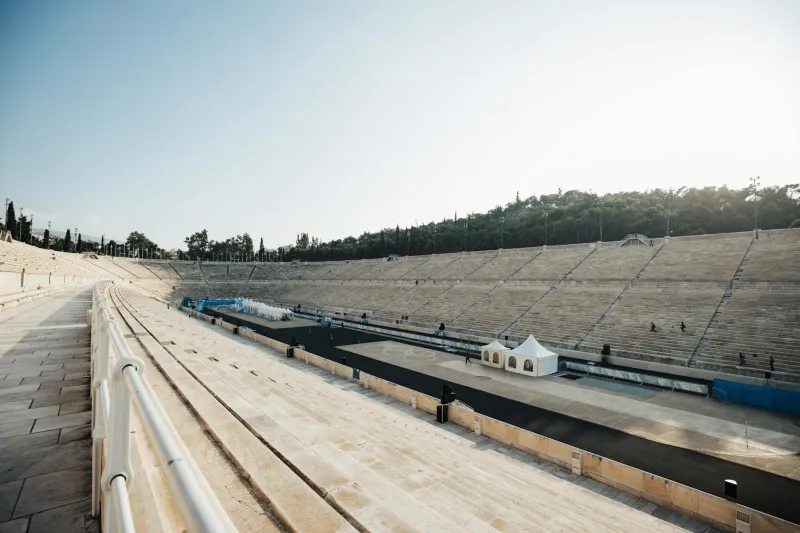
Picture this: Two Greek athletes thunder down the ancient stadion track, their bare feet pounding the packed earth as 40,000 spectators roar from the hillsides. They cross the finish line in what looks like a dead heat. No slow-motion replay. No electronic sensors. No photo finish camera clicking away at 10,000 frames per second.
Just a handful of officials squinting in the Mediterranean sun, trying to determine who gets to wear the olive wreath crown and who goes home empty-handed.
Welcome to Olympic judging, circa 776 BC — where human eyeballs were the most advanced timing technology available.
The Hellanodikai: Greece's Original Referees
The ancient Greeks weren't completely winging it when it came to determining winners. They developed an entire system around officials called the Hellanodikai — literally "judges of the Greeks." These weren't just random spectators with good seats. They were respected citizens, often former athletes themselves, who underwent months of training before each Olympic Games.
The number of Hellanodikai grew over time as the Games expanded. Initially, just one judge oversaw the entire festival. By the height of the ancient Olympics, ten judges managed different events, with multiple officials positioned at crucial points around each competition area.
For the stadion — the premier sprint event that gave the stadium its name — judges positioned themselves at the finish line, crouched low to get the best possible view of runners' torsos crossing the line. They understood that in close races, the first body part to break the plane determined the winner, a principle that survives in modern track and field.
When Close Calls Got Messy
But what happened when even the trained eyes of the Hellanodikai couldn't agree?
Historical records suggest that disputed finishes occasionally erupted into full-blown controversies. Unlike today's athletes who can appeal to video evidence, ancient competitors had to accept whatever the judges decided — or risk being banned from future competitions for unsportsmanlike conduct.
Some accounts describe judges huddling together after particularly close races, debating what they saw before announcing a winner. In extreme cases, they might declare a tie, allowing multiple athletes to share victory. This happened rarely, since the Greeks generally preferred decisive outcomes, but it shows they recognized the limitations of human judgment.
The most famous disputed finish in ancient Olympic history involved the boxer Kleomedes of Astypalaia, who killed his opponent during their match. The judges ruled it wasn't a fair victory, sparking a controversy that followed Kleomedes for the rest of his life — and according to legend, even after his death.
The Science of Ancient Eyeball Judging
Modern sports science tells us that human reaction time averages around 0.2 seconds — meaning even the most alert judge would miss subtle timing differences that electronic systems catch effortlessly today. Ancient Greek judges were essentially making calls within a margin of error that would horrify contemporary officials.
Yet they developed surprisingly sophisticated techniques. Judges learned to focus on specific body parts rather than trying to track entire athletes. They positioned themselves to minimize parallax errors — the visual distortion that occurs when viewing objects from different angles. Some evidence suggests they even used primitive measuring tools to mark exact finish line positions.
The Greeks also understood crowd psychology. Judges were instructed to make their calls quickly and confidently, knowing that hesitation would invite challenges from disappointed athletes and their supporters.
From Olive Wreaths to Photo Finishes
Fast-forward to the 2024 Paris Olympics, where timing systems measure down to 0.001 seconds — a precision that would seem like magic to ancient Greeks. Modern photo finish cameras capture 10,000 images per second, creating a detailed record that can resolve disputes invisible to the human eye.
The contrast is staggering. In 2021, Italian sprinter Lamont Marcell Jacobs won Olympic 100-meter gold in 9.80 seconds. The margin between first and eighth place? Just 0.14 seconds — a gap so small that ancient judges might have declared all eight runners co-champions.
Yet for all our technological advances, we still rely on human judgment in many sports. Boxing, gymnastics, and diving competitions depend on officials making subjective calls that can determine Olympic destinies. The spirit of the Hellanodikai lives on every time a judge raises a scorecard or signals a foul.
The Human Element That Never Disappeared
What's remarkable isn't that ancient Greeks got some calls wrong — it's that they got so many right. Their system produced legendary champions whose achievements echoed through history. Athletes like Leonidas of Rhodes, who won 12 Olympic crowns, earned their status through competitions judged entirely by human observation.
Those ancient officials understood something modern sports sometimes forget: competition isn't just about precision measurement. It's about human drama, split-second decisions, and the eternal quest to determine who's fastest, strongest, or most skilled.
The next time you watch a photo finish decide an Olympic race by thousandths of a second, spare a thought for the Hellanodikai. They were making those same life-changing calls with nothing but their eyes, their training, and their commitment to getting it right.
Sometimes the most advanced technology is still the human element — even when it's imperfect.