Zero to 9.58: How the 100-Meter Dash Went From Bare Feet on Sand to the Fastest Thing in Human Sports
Zero to 9.58: How the 100-Meter Dash Went From Bare Feet on Sand to the Fastest Thing in Human Sports
There is no sporting moment quite like the 100-meter final at the Olympics. Ten seconds. Eight lanes. The whole world holding its breath. But the sprint didn't begin under stadium lights with tens of thousands of screaming fans. It started on a strip of packed sand in ancient Greece, run by athletes who wore nothing at all and competed for an olive wreath.
The distance has changed. The surface has changed. The science behind every stride has been transformed almost beyond recognition. And yet, at its heart, the sprint is still the same primal contest it always was: who gets there first?
The Original Sprint: The Stadion Race
The earliest recorded Olympic Games took place in 776 BC in Olympia, a sanctuary in southwestern Greece dedicated to Zeus. The only event at those first Games was the stadion — a straight-line foot race of roughly 192 meters, or about one length of the stadium. Athletes ran on a track of compacted sand and earth, launched themselves forward from a standing start, and competed completely barefoot.
The stadion was the crown jewel of the ancient Olympics for centuries. Winning it was considered one of the highest honors a Greek citizen could achieve. The victor's name was used to mark that particular Olympiad in historical records — the ancient equivalent of putting your name on a trophy the size of time itself.
We don't have stopwatch data from 776 BC, obviously. But historians and biomechanics researchers estimate that elite ancient Greek sprinters likely ran times somewhere in the range of 13 to 15 seconds for their 192-meter race — roughly equivalent to a 100-meter pace of around 12 seconds. Fast by any everyday standard. Nowhere near what humans are capable of today.
The 1896 Revival and the First Modern Sprint
When Pierre de Coubertin brought the Olympics back to life in Athens in 1896, the sprint was reborn with it — this time measured at 100 meters and contested on a cinder track. The American Thomas Burke won that inaugural modern 100-meter final in a time of 12.0 seconds, using a crouched starting position that was considered radical at the time. Most of his competitors started from a standing position, the way runners had for centuries.
Twelve seconds. That was the benchmark of Olympic excellence at the dawn of the modern era.
For context, today's high school sprinters regularly run faster than that.
A Century of Shaving Seconds
What happened between 1896 and now is one of the most dramatic performance arcs in all of sports history. Each decade brought new developments that chipped away at the world record in fractions of a second — fractions that, at this level, represent enormous leaps in human capability.
Cinder to synthetic. For most of the early and mid-twentieth century, sprinters ran on cinder tracks — loose, uneven surfaces that absorbed energy with every footfall. The introduction of all-weather polyurethane tracks in the 1960s changed everything. The 1968 Mexico City Olympics, held on a new synthetic surface at high altitude (which reduces air resistance), produced a wave of stunning sprint times. Jim Hines became the first man to officially break the 10-second barrier, running 9.95 seconds.
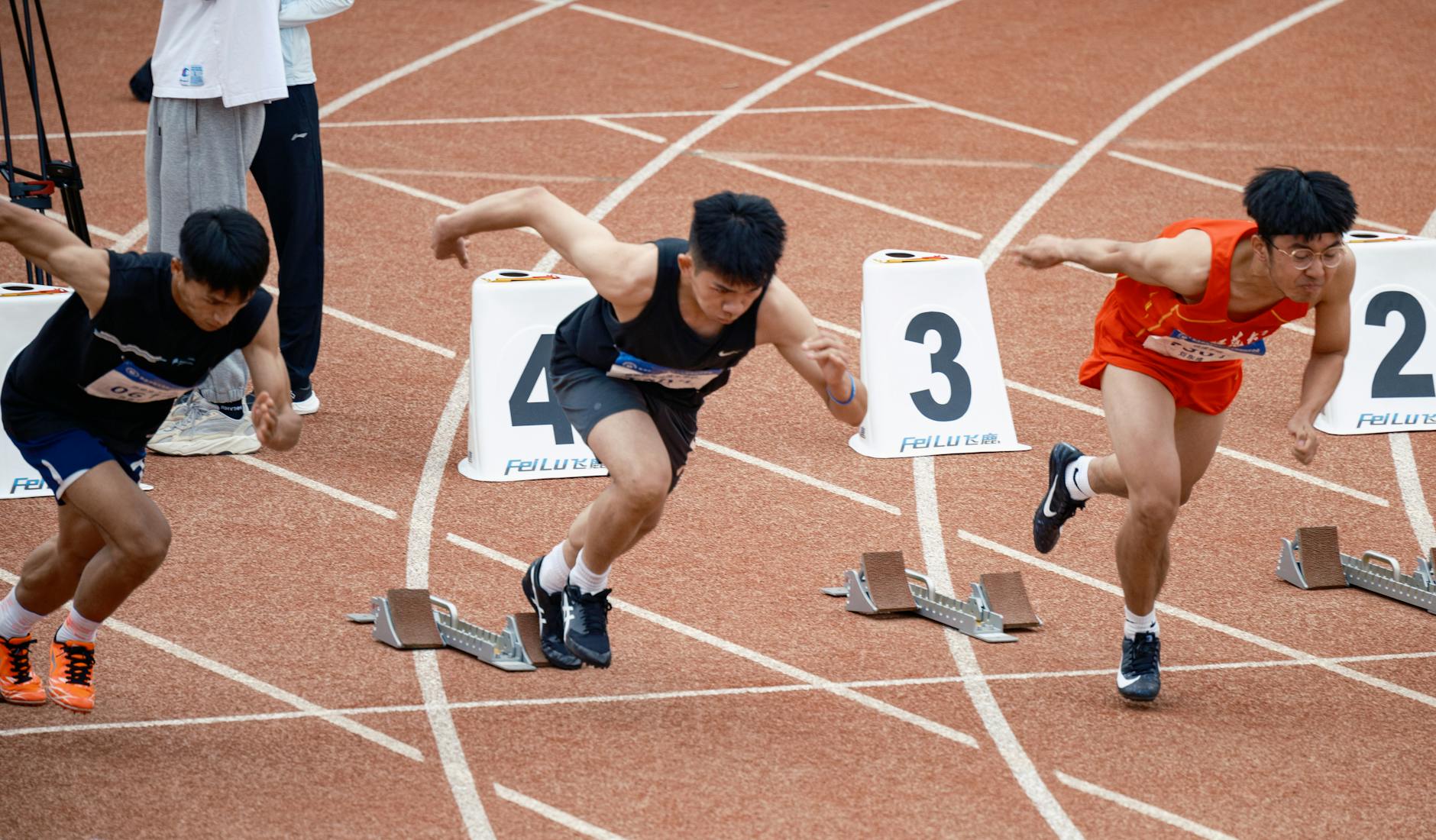
Starting blocks. The crouched start Burke used in 1896 evolved into the use of fixed starting blocks, which were officially introduced in Olympic competition in 1948. Blocks allow sprinters to generate maximum force from a static position, dramatically improving acceleration out of the gate.
Spikes and footwear. Modern sprint spikes are engineered marvels — lightweight, stiff-soled, and designed to transfer as much energy as possible into forward motion. Ancient Greek runners had none of that. Even compared to mid-twentieth century footwear, today's shoes represent a significant performance edge.
Sports science and training. Perhaps the biggest factor of all. Modern sprinters train with GPS-tracked workouts, force plate analysis, high-speed video breakdowns of their mechanics, and personalized nutrition plans. Recovery is treated as seriously as the training itself. The gap between what athletes knew about the human body in 1896 and what coaches know now is almost incomprehensible.
The Bolt Standard
In 2009, at the World Championships in Berlin, Usain Bolt did something that made scientists genuinely reconsider what they thought was possible. He ran 100 meters in 9.58 seconds — a world record that still stands today. At his peak velocity during that race, Bolt reached approximately 27.8 miles per hour.
To put that in perspective: Bolt's record is roughly 20 percent faster than Thomas Burke's 1896 Olympic-winning time. It is almost certainly more than 25 percent faster than the best ancient Greek sprinters ever managed.
Is There a Ceiling?
Here's where it gets genuinely fascinating. Sports scientists and biomechanics researchers have spent years trying to figure out whether human sprinting speed has a hard biological limit — and if so, how close Bolt's record is to it.
The honest answer is: we don't really know. Some researchers have modeled the theoretical maximum speed of a human runner based on muscle fiber composition, ground contact time, and stride mechanics, arriving at estimates somewhere between 9.2 and 9.4 seconds for the 100 meters. Others argue those models underestimate human adaptability.
What most experts agree on is that the low-hanging fruit has been picked. The easy gains — better tracks, better shoes, better starting technique — have already been made. Future improvements will come from the margins: genetics, training optimization, and perhaps technologies we haven't developed yet.
The ancient Greeks ran for the glory of Zeus on a strip of sand. Today's sprinters run for the history books on laser-timed tracks with the whole planet watching. The race looks completely different. The hunger to be first? That hasn't changed in 2,800 years.