On the Brink: The Messy, Almost-Fatal Early Years of the Modern Olympic Games
On the Brink: The Messy, Almost-Fatal Early Years of the Modern Olympic Games
Everybody knows the story of the Olympics. Ancient Greece, a glorious revival in 1896, and then — somehow — the unstoppable global juggernaut that now commands billions of television viewers every four years. It's a tidy narrative. It's also missing a chapter that almost ended the whole thing.
Between 1896 and 1908, the modern Olympic movement came remarkably close to dying quietly in its crib. The Games were financially ruinous, organizationally chaotic, and — at their lowest point — little more than a sideshow attraction at a World's Fair. That the Olympics survived at all is less a story of inevitable triumph and more a story of stubborn persistence, unlikely rescues, and one deeply controversial event that history has largely chosen to forget.
Athens, 1896: A Promising Start That Hid a Fragile Foundation
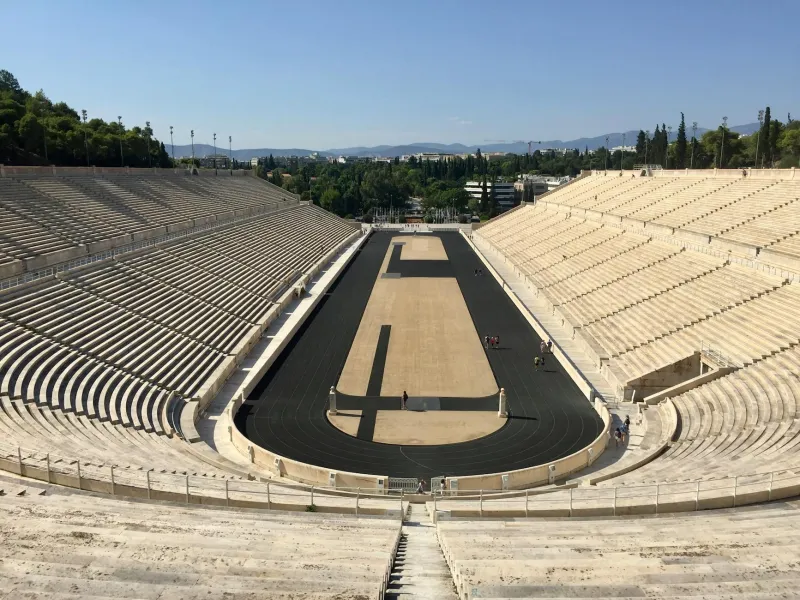
The first modern Olympic Games looked like a success on the surface. Athens in April 1896 drew 241 athletes from 14 nations, and the newly restored Panathenaic Stadium — rebuilt in white marble — gave the whole affair a sense of grandeur that matched its ancient ambitions. American athletes dominated the track events, a Greek runner named Spyridon Louis became a national hero by winning the marathon, and the crowds were enthusiastic.
But behind the scenes, the cracks were already showing. Baron Pierre de Coubertin, the French educator who had pushed hardest for the Games' revival, had a vision for an international, rotating Olympic movement — a celebration of sport that would belong to the world, not to any single nation. The Greeks had a very different idea. They wanted the Olympics to stay in Athens. Permanently.
This wasn't just cultural pride talking. The Greek royal family had thrown significant political weight behind the Games, and the public response had been electric. To the Greeks, Athens wasn't a host city — it was the rightful home of the Olympics, full stop. Coubertin found himself in a diplomatic standoff almost immediately after the opening ceremony.
Paris, 1900, and St. Louis, 1904: When the Olympics Became an Afterthought
If Athens revealed a tension at the heart of the movement, the next two Games nearly killed it outright.
The 1900 Paris Olympics were folded into the Universal Exposition — a massive World's Fair that utterly swallowed them. Events were scattered across weeks and months, venues were poorly organized, and many athletes reportedly didn't even realize they were competing in the Olympics. Some received paper medals or trophies instead of proper awards. The word "Olympic" barely appeared in official documentation. For Coubertin, who had lobbied hard for Paris as the second host city, it was a humiliation.
St. Louis in 1904 was somehow worse. The Games were again attached to a World's Fair — the Louisiana Purchase Exposition — and the logistics were a disaster. The marathon that year became one of the most chaotic athletic events in recorded history, with runners nearly poisoned by road dust, one competitor aided illegally by a car, and the original winner disqualified for being administered strychnine as a stimulant mid-race. Only about a dozen countries sent athletes. European nations largely skipped the trip across the Atlantic entirely.
The Olympic movement, barely a decade old, was running on fumes.
The Intercalated Games: The Rescue Nobody Remembers
Here's where the story gets strange — and where history has been oddly stingy with its credit.
In 1906, Athens hosted what were officially called the Intercalated Games: an intermediate Olympic event designed to be held between the four-year cycle, essentially a midterm check-in for the movement. The idea was Coubertin's concession to the Greeks, who had been pushing for permanent Athens hosting rights. He didn't love the compromise, but the movement needed something.
The 1906 Games were, by almost every measure, a genuine success. Around 900 athletes from 20 nations competed. Events were well-organized. Crowds were enthusiastic. For the first time, nations marched together under their flags in an opening ceremony — a tradition that became a permanent fixture of the Games going forward. Athletes actually knew they were at the Olympics.
And yet the International Olympic Committee has never officially recognized the 1906 Intercalated Games as part of the Olympic record. Medal counts from Athens that year don't appear in official IOC tallies. The athletes who won there don't carry the same historical weight as those who won in 1904 or 1908. It's one of sports history's more peculiar acts of institutional erasure — the Games that arguably saved the Olympics, quietly written out of the official story.
How the Movement Finally Found Its Legs
The 1908 London Games marked a turning point. Held in a purpose-built stadium — not grafted onto a fair or festival — they felt, for the first time, like the Olympics were supposed to feel. There were controversies, including a bitter dispute between the US and British officials over the American flag-bearer's refusal to dip the flag before the royal box (a tradition that American teams maintain to this day). But the organizational infrastructure was there. The Games had a shape.
By 1912 in Stockholm, the modern Olympics had begun to resemble something sustainable. Systematic timing equipment, electronic finish-line technology, and a genuine international athletics federation were all coming online. The movement had survived its adolescence — barely.
Why This Chapter Still Matters
It's easy to look at the Olympics today — the billion-dollar broadcast deals, the purpose-built athlete villages, the global television audiences — and assume this was always where it was heading. It wasn't. For about a decade, the whole project teetered.
What saved it wasn't inevitability. It was a combination of stubborn idealism from Coubertin, the unexpected lifeline of the 1906 Athens Games, and the slow, grinding work of building international sporting infrastructure from scratch. The Olympics didn't become the world's greatest athletic stage because they were destined to. They became it because enough people refused to let them fail — even when failure looked like the more likely outcome.
The next time you watch an opening ceremony and see those delegations marching in under their flags, remember: that tradition was born in 1906, at a Games the IOC doesn't officially count. History is funny that way.