From Warrior Training to Modern Madness: How the Pentathlon Completely Reinvented Itself
The Original All-Around Test
Picture this: It's 708 BC in ancient Olympia, and you're watching the ultimate test of human capability. Five events, one afternoon, designed to crown the most complete athlete in Greece. The pentathlon wasn't just entertainment — it was a military recruitment tool disguised as sport.
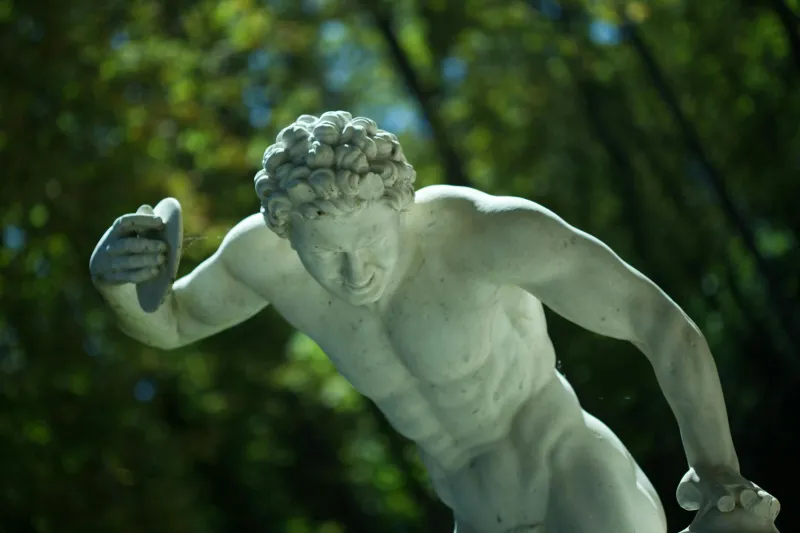
The ancient Greeks believed the pentathlon identified the perfect soldier. Running showed speed and endurance. The long jump demonstrated explosive power. Discus and javelin throwing proved upper body strength and accuracy with weapons. Wrestling? That was hand-to-hand combat training, pure and simple.
Unlike today's specialized athletes who dedicate their entire careers to perfecting one skill, ancient pentathletes had to master everything. They were the Swiss Army knives of the athletic world, capable warriors who could sprint to battle, leap obstacles, hurl spears with deadly accuracy, and grapple enemies to the ground.
When Excellence Meant Everything
The scoring system reveals just how seriously the Greeks took this concept of complete athleticism. You didn't need to win every event — you needed to be consistently excellent across all five. Ancient sources suggest that winning three of the five events typically secured victory, though the exact scoring remains debated by historians.
What we do know is that pentathlon champions were revered above single-event winners. They embodied the Greek ideal of kalokagathia — the perfect combination of physical beauty, moral goodness, and athletic excellence. These weren't just athletes; they were walking advertisements for what human potential could achieve.
Compare that to modern track and field, where a 100-meter specialist might never attempt a discus throw, and you start to see how radically our approach to athletic excellence has shifted.
The 1,500-Year Gap
When the ancient Olympics died out around 394 AD, the pentathlon died with them. For over a millennium and a half, this ultimate test of athletic versatility simply didn't exist in organized sport. The concept survived only in historical texts and the imaginations of scholars studying ancient Greece.
Then came 1896 and the revival of the modern Olympics in Athens. Organizers included several ancient events, but tellingly, the pentathlon wasn't among them. The world had moved on from the Greek ideal of the complete warrior-athlete.
Pierre de Coubertin's Wild Reimagining
Enter Baron Pierre de Coubertin, the driving force behind the modern Olympics, with a vision that would make ancient Greeks scratch their heads in confusion. In 1912, he introduced the "modern pentathlon" to the Stockholm Olympics — and it bore almost no resemblance to its ancient namesake.
Gone were the running, jumping, discus, javelin, and wrestling that had defined the event for centuries. In their place: fencing, swimming, equestrian show jumping, pistol shooting, and cross-country running. Coubertin's reasoning? He wanted to recreate the skills of a 19th-century cavalry officer trapped behind enemy lines.
Imagine the scenario: An officer's horse is shot from under him. He draws his pistol to fight his way out, grabs a sword for close combat, commandeers another horse to escape, swims across a river to evade pursuit, then runs cross-country back to his own lines. It was military fantasy turned into Olympic reality.
America's Pentathlon Puzzle
American athletes have had a complicated relationship with the modern pentathlon. Despite the country's Olympic dominance in many sports, the pentathlon has proven stubbornly challenging for U.S. competitors.
Part of the problem is cultural. The modern pentathlon's European origins show in its required skills — fencing and equestrian sports aren't exactly playground staples in American schools. While European athletes often grow up around these disciplines, American pentathletes typically come to them later, playing catch-up against competitors who've been riding horses since childhood.
The closest America came to pentathlon gold was Robert Beck's silver medal in 1960, though several Americans have claimed individual world championships over the decades. The sport's complexity and expensive training requirements have kept it somewhat niche in a country that excels at more accessible athletic pursuits.
What the Transformation Tells Us
The pentathlon's complete makeover reveals something fascinating about how societies define athletic excellence. Ancient Greeks valued the warrior-athlete who could excel in combat-related skills. Coubertin's era romanticized the gentleman officer who combined physical prowess with refined accomplishments like horsemanship and marksmanship.
Today's version — which has undergone several modifications, including combining running and shooting into a single "laser run" event — reflects our modern values of accessibility and television-friendly formatting. The laser pistols that replaced actual firearms in 2009 make the sport safer and more portable, though purists argue they've diluted the challenge.
The Enduring Appeal of Being Good at Everything
Despite its transformations, the pentathlon still represents something compelling: the idea that true athletic greatness means mastering diverse skills rather than perfecting just one. In an era of increasing specialization, where 10-year-olds are already being groomed for specific sports, the pentathlon stands as a throwback to a more well-rounded approach to human development.
Whether it's teaching ancient Greek warriors to be complete fighting machines or modern athletes to excel across wildly different disciplines, the pentathlon continues to ask the same fundamental question: What does it truly mean to be the best athlete in the world?
The answer, it seems, depends entirely on which century you're asking.