The Pool Revolution: Why Swimming Records Are Really Architecture Achievements
When Water Was the Enemy
The 1896 Athens Olympics featured swimming races held in the choppy waters of the Mediterranean Sea, where competitors battled 12-foot waves and 55-degree temperatures that left some athletes hypothermic. The winner of the 100-meter freestyle, Alfred Hajos of Hungary, later described the experience as "more like a survival test than a swimming competition."
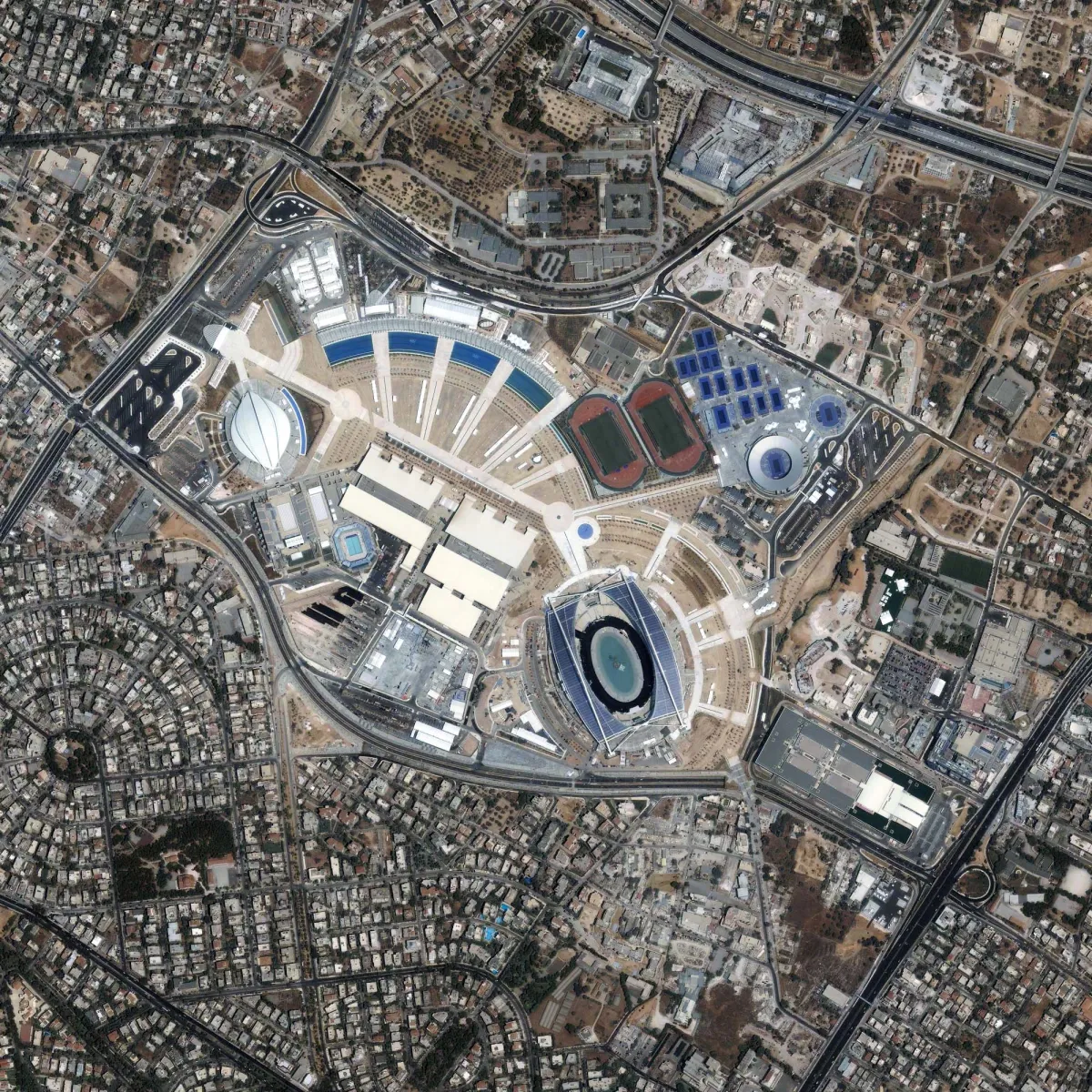 Photo: Athens Olympics, via eoimages.gsfc.nasa.gov
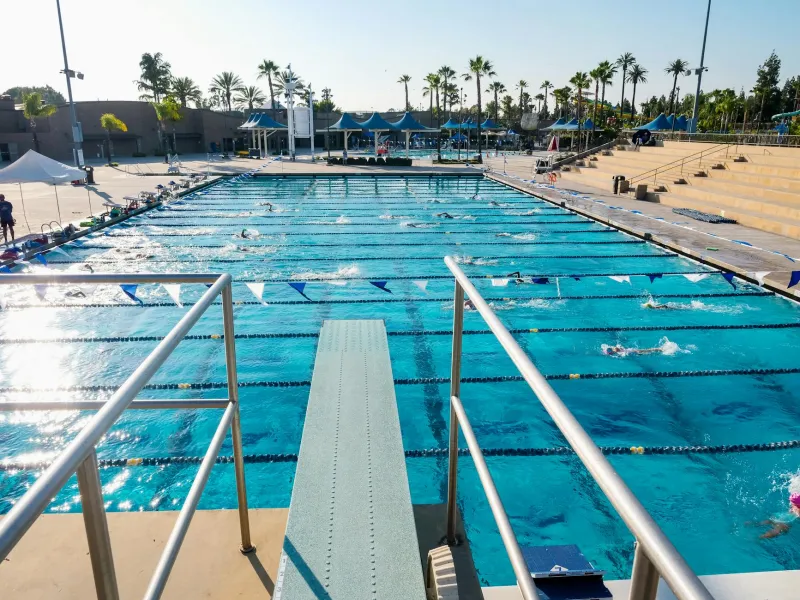
Fast-forward to the 2008 Beijing Olympics, where Michael Phelps shattered seven world records in a pool so precisely engineered that the water temperature was maintained within 0.5 degrees Celsius, the depth calibrated to eliminate turbulence, and lane ropes designed to absorb rather than reflect wave energy.
 Photo: Beijing Olympics, via www.sasaki.com
These aren't the same sport. They just happen to involve humans moving through water.
The Concrete Game-Changer
The first purpose-built Olympic swimming venue appeared at the 1908 London Games—a 100-meter pool constructed inside the White City Stadium. It was a revelation: calm water, measured distances, consistent conditions. Times dropped immediately, not because swimmers suddenly got faster, but because they were finally competing against each other instead of against the environment.
This shift from natural to artificial swimming environments represents one of sport's most dramatic technological revolutions. Early swimmers were essentially aquatic athletes adapting to whatever water they found. Modern swimmers are precision instruments calibrated to specific conditions that didn't exist in nature.
The 1924 Paris Olympics introduced the 50-meter pool standard that persists today, but even calling it a "standard" misses how radically different these early pools were from modern facilities. The Paris pool had no lane ropes, minimal depth, and water circulation systems that would be considered primitive by today's standards.
Engineering Speed: The Lane Rope Revolution
Most fans assume lane ropes exist to keep swimmers in their lanes, but their real purpose is wave management. The floating discs that make up modern lane ropes are engineered to absorb and dissipate the energy that swimmers create as they move through water, preventing it from bouncing off pool walls and interfering with adjacent competitors.
This seemingly simple innovation didn't appear until the 1960s, which means every swimming record set before then was achieved in conditions that would be considered unacceptably turbulent today. Johnny Weissmuller's famous 100-meter freestyle world record of 58.6 seconds, set in 1922, was accomplished in a pool where his own wake was his biggest opponent.
Modern lane rope technology is so sophisticated that pool designers calculate the optimal disc size, spacing, and material composition for different racing distances. The lane ropes used in Olympic finals cost more than most cars and represent decades of hydrodynamic research.
The Depth Advantage
Pools got deeper for a simple reason: speed. Shallow water creates turbulence as swimmers' strokes and kicks interact with the pool bottom, generating drag that slows everyone down. The minimum depth for Olympic competition is now 2 meters, but most modern racing pools go deeper—3 meters is increasingly standard for elite competition.
This depth revolution explains why comparing swimming times across eras becomes almost meaningless. Weissmuller's records were set in pools that were often less than 4 feet deep. Modern swimmers like Katie Ledecky race in pools designed to eliminate every possible source of water resistance.
The difference isn't just theoretical. Studies have shown that swimmers can be 2-3% faster in optimally designed pools compared to older facilities—a margin that represents the difference between world records and also-ran performances at the elite level.
The Chemistry of Champions
Water quality might be the most overlooked factor in swimming's technological evolution. Early Olympic pools were often filled with whatever water was locally available, treated with basic chlorination, and rarely tested for the chemical factors that affect performance.
Modern Olympic pools maintain water chemistry with pharmaceutical precision. pH levels, alkalinity, chlorine concentration, and water hardness are monitored continuously and adjusted in real-time. The water in an Olympic pool is often cleaner and more precisely balanced than the water coming out of nearby drinking fountains.
This chemical precision affects performance in ways most fans never consider. Improperly balanced water can irritate swimmers' eyes and skin, affecting their technique and endurance. Hard water increases drag; soft water can cause lane ropes to behave unpredictably. The 2008 Beijing Olympics famously featured water so perfectly balanced that swimmers joked it felt "fast."
The Gutter System Revolution
Pool gutters—the channels that run along pool edges—represent another invisible technological leap. Early pools used simple overflow systems that created turbulence as water spilled over the edges. Modern pools feature sophisticated gutter designs that create a "knife edge" effect, allowing water to flow smoothly without generating waves that could interfere with racing.
The introduction of deck-level gutters in the 1970s was as significant for swimming as the shot clock was for basketball. Suddenly, pools could maintain perfectly calm surfaces throughout competition, eliminating a major variable that had affected racing for decades.
When Technology Meets Talent
None of this technological evolution diminishes the achievements of swimmers past or present. Weissmuller was undoubtedly faster relative to his competition than Phelps was to his. But it does complicate any attempt to compare performances across eras.
Modern swimmers aren't just benefiting from better training, nutrition, and technique—they're racing in environments that have been engineered for speed in ways that would seem like science fiction to earlier generations of competitors.
The pool at the 2024 Paris Olympics will feature innovations that didn't exist when Phelps was setting records in Beijing. Underwater cameras track swimmers' stroke rates in real-time, current systems ensure perfect water circulation, and starting blocks are calibrated to optimize reaction times.
The Invisible Infrastructure of Excellence
Perhaps the most remarkable aspect of swimming's technological revolution is how invisible it remains to spectators. Fans see swimmers getting faster and assume it's about human improvement—better athletes, superior training, enhanced techniques.
The reality is more complex and more interesting. Swimming's evolution reflects humanity's broader relationship with technology: we don't just adapt to our environments anymore, we engineer them to optimize performance. The pool has become as much a part of the sport as the swimmers themselves.
This raises fascinating questions about athletic achievement in the modern era. When a swimmer breaks a world record, how much credit belongs to the athlete, and how much to the army of engineers, chemists, and designers who created the environment that made the record possible?
The answer probably doesn't matter to fans cheering in the stands. But it does suggest that swimming's next great revolution might not come from a more talented athlete—it might come from an even better pool.