Sacred Judges to Striped Shirts: The Wild Evolution of Sports Officials
Picture this: You're a sprinter in ancient Greece, 400 BC, and you've just been caught false-starting at the Olympic Games. There's no yellow card, no technical foul, no three-strike system. Instead, a priest-judge called a Hellanodikai steps forward with a whip and delivers your punishment right there on the track. Welcome to the original world of sports officiating, where religious authority met athletic competition in ways that would make modern fans' heads spin.
When Gods Called the Shots
The ancient Olympics weren't just athletic competitions—they were sacred festivals honoring Zeus. This religious foundation shaped everything about how the games were run, including who got to make the calls. The Hellanodikai, literally meaning "judges of the Greeks," weren't your typical refs. These were respected citizens chosen for their moral character and knowledge of athletic traditions, serving what amounted to a religious duty.
These ancient officials had powers that would make today's referees jealous. They could disqualify athletes, impose fines, order public floggings, and even ban competitors from future games. There were no appeals, no video reviews, no arguing with the call. When a Hellanodikai made a decision, it carried the weight of divine authority.
The most famous case involved the boxer Eupolus of Thessaly, who was caught bribing his opponents in 388 BC. The judges didn't just disqualify him—they used the fine money to commission bronze statues called "Zanes" that were placed along the path to the Olympic stadium, each inscribed with warnings about cheating. Talk about public shaming with staying power.
The Medieval Muddle
When the ancient Olympics died out around 400 AD, organized sports largely disappeared with them, and so did formal officiating. For over a thousand years, most athletic competitions were informal affairs—village festivals, military training, or noble entertainment where disputes were settled by whoever had the loudest voice or the biggest sword.
Medieval tournaments had marshals who theoretically oversaw jousting competitions, but these were more like event coordinators than impartial judges. The concept of neutral officiating had essentially vanished from Western culture, replaced by a might-makes-right approach that reflected the broader social order.
The Birth of Modern Referees
The resurrection of organized officiating came alongside the codification of modern sports in 19th-century Britain. As games like soccer, rugby, and cricket developed formal rules, someone needed to enforce them. The solution was elegantly simple: ask a respected gentleman to oversee the match.
The first soccer referee appeared in 1891, but initially, teams were expected to police themselves through designated captains. Only when disputes couldn't be resolved would they consult the "referee"—literally someone to whom they could "refer" disagreements. This honor-system approach worked about as well as you'd expect, which is why the role quickly evolved into active game management.
Baseball pioneered many modern officiating concepts in America. The first professional umpire, Billy McLean, was hired in 1878, establishing the precedent that officials should be paid professionals rather than volunteers or part-timers. This was revolutionary—it meant umpires could make decisions without worrying about alienating local fans or influential team owners.
The American Innovation
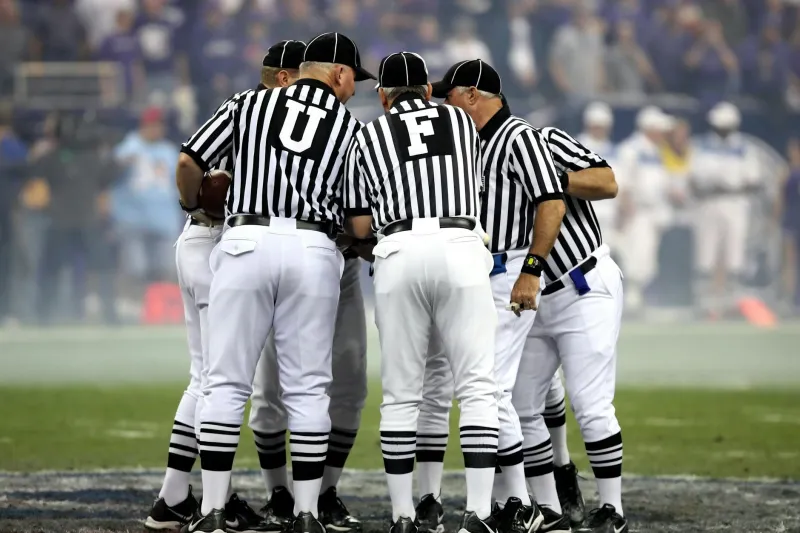
While Britain gave us formal rules and referees, America perfected the art of sports officiating. We invented the striped shirt (borrowed from prison uniforms, ironically), developed complex signaling systems, and created the multi-official crew system that most major sports use today.
American football led the charge with its elaborate officiating structure. What started with a single "referee" in early college games evolved into today's seven-person crews, each with specialized responsibilities. The head linesman watches for offsides, the back judge covers deep passes, the umpire monitors the line of scrimmage—it's like a carefully choreographed dance of rule enforcement.
Basketball contributed the concept of multiple officials working in coordination, while baseball gave us the idea that different types of calls require different expertise. The home plate umpire handles balls and strikes, while base umpires focus on safe-or-out calls—a division of labor that ancient Greek judges would have found bewildering.
Technology Changes Everything
The biggest revolution in sports officiating since the ancient Greeks came in the form of instant replay. When the NFL introduced replay review in 1986, it fundamentally changed the relationship between human judgment and technological precision. Suddenly, the referee's word wasn't final—cameras could overrule even the most experienced official.
This shift mirrors broader changes in how we think about authority and accuracy. Ancient Greek judges derived their power from religious and social standing. Modern officials rely on expertise and training. But replay technology suggests that what we really want is objective truth, even if it comes from a machine.
Today's officials navigate a complex landscape of live-action decision-making supplemented by technological assistance. The NBA's Last Two Minute Report, which reviews all officiating decisions in close games, would have seemed like science fiction to those ancient Greek priests—but it serves the same basic function of maintaining competitive integrity.
The Human Element Endures
Despite all our technological advances, sports officiating remains fundamentally human. Cameras can tell us if a tennis ball was in or out, but they can't judge the intent behind a basketball foul or determine what constitutes "excessive celebration" in football. The interpretive aspects of officiating—the judgment calls that make fans scream at their TVs—still require human officials making split-second decisions under intense pressure.
Modern referees face challenges those ancient Greek judges never imagined: 24/7 media scrutiny, slow-motion replay that reveals every mistake, and social media that can turn a blown call into a national controversy within minutes. Yet they also have advantages the Hellanodikai lacked: extensive training programs, clear rulebooks, and technological tools to help them get calls right.
From Sacred to Professional
The evolution from priest-judges to professional referees reflects broader changes in how we organize society. Ancient Greeks saw athletic competition as inseparable from religious worship, so it made sense for priests to oversee the games. Modern sports are secular entertainment, so we want neutral professionals making the calls.
But some things never change. Whether it's an ancient Greek athlete arguing with a Hellanodikai or a modern basketball coach working the refs, sports have always been about more than just following rules—they're about competing for every possible advantage, including trying to influence the people who enforce those rules.
The next time you watch a referee make a controversial call, remember: you're witnessing the latest chapter in a story that began over 2,500 years ago with Greek priests wielding whips in the shadow of Mount Olympus. The technology has changed, the uniforms have evolved, but the fundamental human drama of trying to enforce fairness in competition remains exactly the same.