The Starting Line Revolution: How Sprinters Went From Scratching Dirt to Lightning-Fast Launches
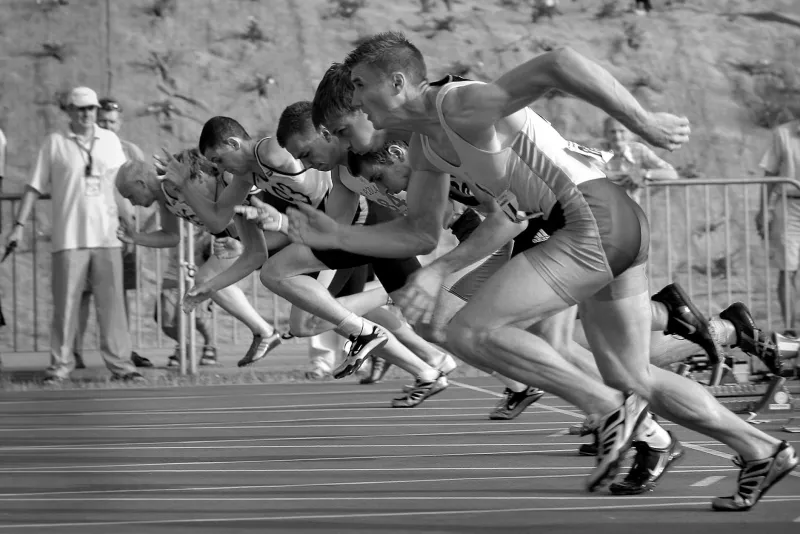
When Sprinters Had to Dig Their Own Starting Line
Picture this: It's 776 BC in ancient Olympia, and you're about to run the most important race of your life. There's no fancy track, no lane markers, and definitely no starting blocks. Instead, you drop to your knees and start frantically clawing at the dirt with your bare hands, desperately trying to carve out footholds that might give you the edge you need.
This wasn't just the reality for ancient Greek sprinters—it was their only option. The stadion, that legendary 200-meter dash that launched competitive athletics, began with runners literally digging their own starting positions into whatever surface they found. Some got creative, using sharp stones or sticks to carve deeper grooves. Others relied purely on finger strength and determination.
The results? Wildly inconsistent starts that could make or break an entire race before it even began.
The Medieval Dark Ages of Sprint Starts
When the ancient Olympics disappeared around 400 AD, so did most organized sprinting. For over a thousand years, running competitions were informal affairs—village festivals, military training, or spontaneous challenges between neighbors. Starting techniques became even more primitive, if that was possible.
Medieval runners often used whatever was handy: tree roots, rocks, or simply lined up shoulder-to-shoulder and hoped for the best. There was no standardization, no science, and certainly no understanding of how a good start could shave precious time off a sprint.
The Victorian Era: Standing Starts and Gentlemanly Racing
When modern track and field emerged in 19th-century Britain and America, sprinters adopted what seemed like a more civilized approach: the standing start. Runners would line up upright, wait for the gun, and then begin running.
It looked dignified, sure, but it was also incredibly slow by today's standards. The first recorded 100-meter dash at the modern Olympics in 1896 was won in 12.0 seconds—a time that wouldn't qualify a decent high school sprinter today.
American colleges began experimenting with crouched starts in the 1880s, with runners placing their hands on the ground and coiling their bodies like springs. The technique looked undignified to Victorian sensibilities, but the results spoke for themselves: runners were consistently faster.
The Breakthrough: Holes in the Ground, Round Two
By the early 1900s, sprinters had rediscovered what their ancient Greek predecessors knew: you need something to push against. But instead of clawing at dirt, they began using small shovels to dig precise holes for their feet.
This created its own problems. Tracks became pockmarked with holes after every race. Maintenance crews spent hours filling and smoothing surfaces. Weather could turn carefully dug footholds into muddy disasters. And if you were unlucky enough to get stuck in lane 8, you might find yourself trying to sprint out of someone else's poorly positioned holes.
The 1912 Olympics in Stockholm saw sprinters spending as much time digging as warming up. It was effective but chaotic—and track officials knew there had to be a better way.
The Game-Changer: Birth of the Starting Block
The breakthrough came in the 1920s when American coach and former sprinter George Bresnahan developed the first portable starting blocks. His design was simple but revolutionary: two adjustable metal or wooden blocks mounted on a base that could be positioned anywhere on the track.
Suddenly, sprinters could get consistent, powerful starts without destroying the track surface. The blocks could be adjusted for individual runners' preferences—foot spacing, angle, height—creating personalized launch pads that maximized each athlete's explosive power.
The first Olympic Games to officially use starting blocks were the 1948 London Olympics, and the impact was immediate. Winning times dropped noticeably as runners could channel more of their energy into forward motion rather than fighting for traction.
The Science of the Perfect Launch
Modern starting blocks aren't just metal footrests—they're precisely engineered pieces of athletic equipment. Today's blocks feature:
- Adjustable angles that can be customized to each runner's biomechanics
- Pressure sensors that detect false starts with millisecond accuracy
- Non-slip surfaces that provide maximum grip without damaging spikes
- Quick-release mechanisms for rapid lane changes between heats
The blocks are positioned based on complex calculations involving leg length, muscle fiber composition, and reaction time patterns. Elite sprinters work with biomechanics experts to find their optimal block settings, sometimes adjusting by mere millimeters to gain hundredths of a second.
Numbers Don't Lie: The Starting Block Advantage
The difference is staggering when you compare reaction times and first-step speeds:
- Ancient Olympics: Reaction times varied wildly, often 0.5+ seconds
- 1896 Standing Start: Average reaction time around 0.3-0.4 seconds
- 1920s Crouched Start with holes: Around 0.2-0.3 seconds
- Modern Starting Blocks: Elite sprinters average 0.12-0.16 seconds
That improvement of roughly 0.3 seconds might not sound like much, but in a 100-meter race where gold medals are decided by thousandths of a second, it's the difference between making history and watching from the stands.
Why Ancient Sprinters Would Dominate Today (Maybe)
Here's the fascinating twist: while modern starting blocks have revolutionized sprint beginnings, ancient Greek sprinters might have had advantages we've lost. They trained barefoot on uneven surfaces, developing incredible balance and adaptability. Their hand-dug starting holes required improvisation and mental toughness that modern athletes rarely face.
Imagine Usain Bolt having to claw his own footholds before setting the 100-meter world record. Would he have been as dominant? Or would the ancient Greeks' resourcefulness and raw determination have given them an edge?
The Evolution Continues
Today's starting blocks continue evolving. Researchers are experimenting with smart blocks that provide real-time feedback on push-off angles and force distribution. Some experimental designs even adjust automatically based on each runner's biomechanics.
But the core principle remains the same as it was 2,800 years ago in ancient Olympia: to run fast, you need something solid to push against. Whether that's dirt carved by fingernails or a precision-engineered block monitored by computers, the goal is identical—transforming human potential into pure speed.
The starting line revolution proves that sometimes the smallest innovations create the biggest leaps forward. From ancient Greeks scratching in the sand to modern sprinters exploding from high-tech blocks, the quest for the perfect start continues to push human speed to its absolute limits.