When Every Second Counted for Nothing: The Wild Journey From Eyeball Judging to Split-Second Precision
When Every Second Counted for Nothing: The Wild Journey From Eyeball Judging to Split-Second Precision
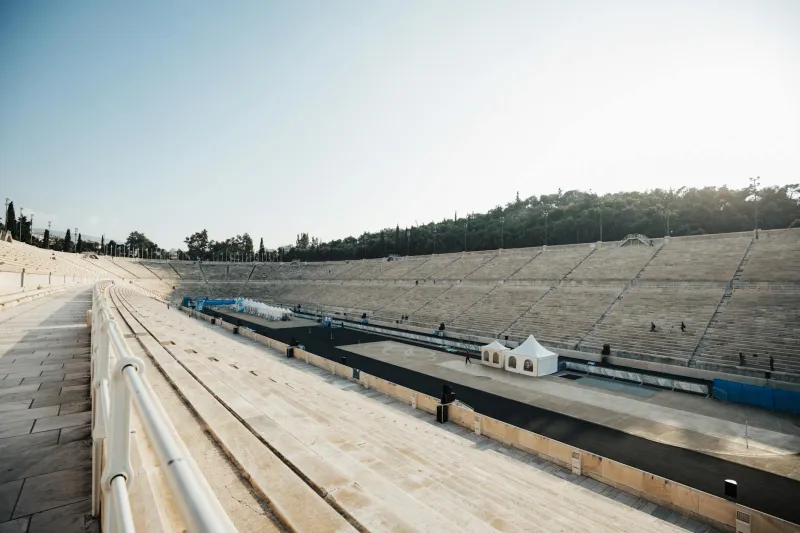
Picture this: You're at the ancient Olympics in 776 BC, watching the stadion race—basically a 200-meter sprint down a straight track. The crowd roars as runners barrel toward the finish line, and then... that's it. A judge standing at the end points to whoever he thinks crossed first. No photo finish. No electronic timing. No heated debates about who won by a nose hair. Just one guy's best guess.
Fast-forward to today's Olympics, where swimmers can lose gold medals by four-thousandths of a second—a margin so small it's literally faster than the blink of an eye. The journey from "eh, close enough" to obsessing over microscopic time differences didn't just change record books. It completely transformed how we think about human athletic potential.
The Ancient Art of Eyeball Officiating
For nearly 1,200 years, the ancient Olympics operated on what we'd now consider a hilariously imprecise system. Judges called Hellanodikai would position themselves at the finish line and simply declare winners based on what they saw. No backup. No instant replay. No appeals process.
This wasn't necessarily a problem back then. The stadion race was short enough that clear winners usually emerged, and the Greeks were more interested in honoring Zeus than splitting hairs over hundredths of seconds. The concept of a "personal best" didn't even exist—athletes competed for glory and olive wreaths, not to shave milliseconds off previous performances.
But even the Greeks knew their system had flaws. Ancient texts describe disputes over close finishes, and some races apparently ended in ties when judges couldn't agree on a winner. One account from the 4th century BC describes a stadion race so close that different judges declared different winners, leading to a heated argument that probably lasted longer than the actual race.
When Clocks Finally Showed Up to the Party
The revival of the modern Olympics in 1896 brought many innovations, but precise timekeeping wasn't one of them. Early Olympic organizers used pocket watches and stopwatches—basically the same technology your great-grandfather might have used to time his morning eggs.
The first "official" Olympic record was set by American Thomas Burke in the 100-meter dash, clocked at 12.0 seconds flat. But here's the kicker: that time was probably wrong. Hand-timing with mechanical stopwatches typically ran slow, and different timekeepers often recorded different results for the same race. Burke might have actually run 11.8 or 12.2—nobody really knew for sure.
This created a bizarre situation where Olympic records were more like educated guesses than precise measurements. Athletes could break "world records" simply because the timekeeping got more accurate, not because they actually ran faster.
The Photo Finish Revolution
Everything changed in 1932 at the Los Angeles Olympics when organizers introduced photo finish cameras. Suddenly, those agonizingly close races that had sparked arguments for centuries could be settled definitively. The camera didn't lie, didn't blink, and didn't have a favorite athlete.
The impact was immediate and dramatic. Races that officials had called as ties were revealed to have clear winners separated by inches. Athletes who thought they'd won discovered they'd actually finished second. The photo finish didn't just settle disputes—it revealed how many disputes there had been all along.
But even photo finishes had their limitations. Early cameras captured maybe 100 frames per second, which sounds fast until you realize that elite sprinters cover more than 30 feet per second at top speed. A lot could happen between frames.
Enter the Electronic Age
The real game-changer came in the 1960s with electronic timing systems. Instead of relying on human reflexes to start and stop watches, these systems used sensors and electronic signals to measure time with unprecedented precision. Suddenly, races could be timed to the hundredth of a second, then the thousandth.
The 1972 Munich Olympics marked the first Games where electronic timing was mandatory for track events. The difference was staggering. Hand-timed world records that had stood for years were suddenly revealed to be slower than previously thought. Jim Hines' famous 9.95-second 100-meter dash from 1968—the first sub-10-second time—was re-evaluated as 9.95 when measured electronically, but many other records weren't so lucky.
The Microsecond Obsession
Today's timing technology borders on the ridiculous. Swimming events are now timed to the thousandth of a second using quantum clocks that are accurate to within one second over 100 million years. Touch pads in swimming pools can detect pressure differences as small as 1.5 kilograms—about the weight of a laptop.
This precision has created a new category of heartbreak in sports. At the 2008 Beijing Olympics, swimmer Milorad Čavić appeared to touch the wall first in the 100-meter butterfly, but electronic timing showed Michael Phelps had won by one-hundredth of a second. The margin was so small that it sparked conspiracy theories and frame-by-frame analysis that would have made ancient Greek judges laugh.
How Precision Changed Everything
The evolution of timekeeping didn't just make sports more accurate—it fundamentally changed how athletes approach competition. When every hundredth of a second matters, training becomes obsessively scientific. Athletes now analyze their technique down to individual muscle contractions, optimize their nutrition to the gram, and study video footage of their performances frame by frame.
Modern swimmers spend hours perfecting their turns because a sloppy wall touch can cost them a tenth of a second. Sprinters practice their starts with electronic sensors measuring their reaction times to the thousandth of a second. The margin for error has essentially disappeared.
The Human Cost of Perfection
This obsession with precision has created new pressures that ancient athletes never faced. When races are decided by margins smaller than human perception, the difference between Olympic gold and going home empty-handed can come down to factors completely outside an athlete's control—a slightly faster lane assignment, a favorable wind reading, or even the ambient temperature of the pool.
Some argue we've gone too far. Do we really need to measure swimming times to the thousandth of a second when the human body can't even perceive such tiny differences? Have we turned sport into a technology arms race where equipment and measurement precision matter more than pure athletic ability?
Why Ancient Timing Still Matters
The journey from eyeball judging to atomic precision tells us something profound about human nature. We've always wanted to know who's fastest, strongest, or best—but our definition of "knowing" has become infinitely more demanding.
Ancient Greek athletes competed for glory and honor, measured in olive wreaths and poems sung by bards. Modern athletes compete for glory too, but it's now measured in increments so small they're literally invisible to the human eye. Both approaches have their merits, but the evolution shows just how far we'll go in pursuit of the perfect measurement of human achievement.
The next time you watch a race decided by thousandths of a second, remember those ancient Greek judges squinting at the finish line, making their best guess about who crossed first. They might not have had electronic precision, but they understood something we sometimes forget: sport is ultimately about human beings pushing their limits, not about the clocks that measure them.