The Backward Revolution: How One Athlete's Wild Leap Rewrote the Science of the High Jump
The Backward Revolution: How One Athlete's Wild Leap Rewrote the Science of the High Jump
Imagine watching someone run toward a bar, leap into the air, and sail over it face-first, chest forward, legs trailing behind like a flag in the wind. For most of the 19th century, that was just called jumping. It was intuitive, natural, and completely unscientific. Nobody had a coaching manual. Nobody had a biomechanics lab. You just ran, you leaped, and you either cleared the bar or you didn't.
That's more or less how the high jump started — and the distance between that moment and today's elite competition is one of the most dramatic technical evolutions in the entire history of sport.
A Gentleman's Game in the Scottish Countryside
The high jump as a formalized competition traces its roots to 19th-century Scotland, where it appeared in Highland Games gatherings alongside events like stone-putting and hammer-throwing. These weren't exactly precision athletic contests. They were community festivals with a competitive edge, the kind of thing where local farmers and laborers tested their physical limits against each other in front of their neighbors.
The earliest recorded high jump competition of note took place around 1864, when the event appeared on the program at the English Championships. The technique? What historians now call the Scissors jump — athletes approached the bar at an angle, swung one leg up and over, then brought the other leg across in a scissoring motion. It was upright, dignified, and looked more like someone stepping over a puddle than competing in an athletic event.
For a sport that would eventually become a battle against gravity itself, it had a remarkably casual beginning.
The Bar Keeps Rising — and So Does the Ambition
As the sport spread through the late 1800s and into the early 1900s, athletes began tinkering. The Scissors jump gave way to the Eastern Cutoff, which allowed for a slightly more horizontal body position over the bar. Then came the Western Roll, where jumpers rotated their entire body to face downward as they crossed. Each variation was an attempt to get more of the body lower — closer to the bar — to waste less energy fighting height that didn't need to be cleared.
By the time the high jump debuted at the 1896 Athens Olympics, the world record stood at around 6 feet 5 inches. Ellery Clark of the United States won that inaugural Olympic event with a jump of just over 5 feet 11 inches — impressive for the era, but a number that would look almost modest against what was coming.
The Straddle technique, which emerged in the 1930s and dominated the sport through the 1960s, pushed records past 7 feet for the first time. American Charley Dumas cleared 7 feet in 1956. John Thomas nearly reached 7 feet 4 inches by 1960. The sport was evolving, and the human body was being asked to do increasingly specific, trained, and deliberate things to clear a bar that kept moving skyward.
But all of it — every technique from the Scissors to the Straddle — shared one thing in common: athletes went over the bar face-down.
The Kid Who Jumped Backward Into History
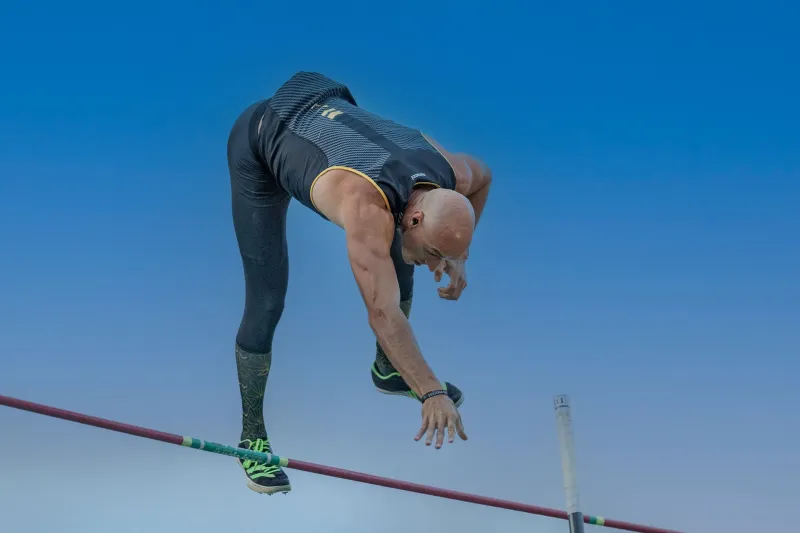
In 1968, Dick Fosbury showed up to the Mexico City Olympics and did something that made coaches wince and crowds gasp. He ran toward the bar, curved his approach, planted his foot, and launched himself backward — arching his back over the bar with his face pointing straight up at the Mexican sky, his body bending like a parenthesis in midair.
 Photo: Mexico City, via i.natgeofe.com
 Photo: Dick Fosbury, via assets-webp.khelnow.com
It looked wrong. It looked dangerous. It looked, to many observers, like a mistake.
Fosbury cleared 7 feet 4 ¼ inches and took home the gold medal.
The technique — quickly dubbed the Fosbury Flop — wasn't just a stylistic quirk. It was a physics breakthrough. By going over the bar backward with an arched back, Fosbury discovered that a jumper's center of mass could actually pass below the bar even as the body clears it. Each part of the body — head, shoulders, hips, legs — crosses the bar sequentially, never all at once. The net result is that the body clears a height it technically shouldn't be able to reach.
Coaches initially dismissed it. Many thought it was a one-man novelty act that wouldn't survive contact with serious competition. They were spectacularly wrong. Within a decade, virtually every elite high jumper on the planet had converted to the Flop. Today, you will not find a single world-class competitor using any other method.
What the Numbers Actually Tell Us
The world record in the high jump currently sits at 8 feet ¼ inch, set by Cuban athlete Javier Sotomayor back in 1993 — a mark that has stood for more than three decades and remains one of the most durable records in all of track and field.
Now consider this: the first recorded high jump champion at the modern Olympics cleared roughly 5 feet 11 inches. That's a difference of more than two feet in just over a century of competition. In a sport measured in inches and fractions of inches, two feet is an almost incomprehensible gulf.
If you transported one of those early Scottish Highland Games competitors to a modern track meet and showed them what today's athletes do — the curved run-up, the backward launch, the arched flight, the foam landing pit — they likely wouldn't recognize it as the same event. The bar, the concept, and the competitive spirit would be familiar. Everything else would look like science fiction.
Why the Flop Still Matters
The story of the high jump is really a story about human stubbornness versus human ingenuity. For almost a century, athletes assumed the most natural-looking approach was the most effective one. It took a college kid willing to look ridiculous to prove that physics didn't care about appearances.
That's a lesson that echoes across the entire history of sport. From running shoes to swimming suits to pole vault poles, every era has had its Fosbury moment — the point where someone looked at an accepted method and decided there had to be a better way.
The high jump just happens to have one of the most dramatic versions of that story. And unlike most athletic revolutions, this one has a very specific name, a very specific date, and a very specific city where everything changed.
Mexico City. 1968. Backward into the future.