Racing Against a Number: How the Stopwatch Gave Athletes an Opponent They Could Never Beat
For most of human athletic history, a race ended when someone crossed a line first. That was it. That was the whole story. One person was faster than everyone else on that particular afternoon, in those particular conditions, and they won. Nobody asked by how much. Nobody wondered if the winner could have gone faster under different circumstances.
The stopwatch changed that. Slowly, then all at once, precise timekeeping transformed athletic competition from a contest between people into a contest between a person and a number — a number that didn't breathe, didn't fatigue, and didn't care about wind or weather or nerves.
It's one of the most consequential technological shifts in the history of sport, and most people have never stopped to think about it.
When Winning Was Enough
The ancient Greeks weren't interested in how fast their champions ran. The Olympics were a festival, not a data collection exercise. Victory was the point — victory in front of witnesses, victory that brought honor to your city-state and glory to Zeus. The margin of victory was irrelevant. There were no world records because there was no mechanism to establish them, and frankly, no cultural appetite for that kind of measurement.
Even as organized sport began to take shape in 18th and 19th-century America and Britain, timing was imprecise enough to be almost meaningless. Pocket watches existed, but their accuracy varied wildly. Judges operated by hand and eye, starting their timepieces when a race began and stopping them when a runner crossed the line. Human reaction time alone introduced errors measured in tenths of a second — which, in sprint competition, is the difference between a world record and an also-ran.
The results were recorded, but nobody put too much stock in the exact figures. What mattered was who crossed the line first.
The Mechanical Revolution
The introduction of purpose-built stopwatches in the mid-1800s began shifting that mindset. By the time the modern Olympics launched in Athens in 1896, hand-timing with mechanical stopwatches was the established standard for track events. Times were recorded to the nearest fifth of a second — crude by modern standards, but a genuine step toward quantifying human performance.
Those early Olympic times look almost leisurely today. The winning 100-meter time at the 1896 Games was 12.0 seconds. The winning 1500 meters clocked in at 4:33. These weren't slow athletes by the standards of their era — they were the best in the world. But the times themselves revealed something important: once you started measuring, you created a baseline. And once you had a baseline, every future performance was automatically a comparison.
The record was born. And with it, a new kind of pressure.
Hundredths of a Second and the Photo Finish
For decades, hand-timing remained the gold standard despite its obvious limitations. Different officials operating different watches at the same race routinely recorded different times. The official result was often an average of multiple readings — a practice that would horrify modern sports scientists but was simply accepted as the cost of doing business.
The photo finish camera, introduced at the 1948 London Olympics, cracked open a new era. Suddenly, it wasn't just possible to determine who crossed the line first in extremely close races — it was possible to measure the margin between them with genuine precision. The camera captured the exact position of every competitor at the moment of crossing, and timing could be synchronized to that image.
Times were now recorded to the hundredth of a second. That might sound like a minor refinement, but it fundamentally altered the competitive landscape. Races that would previously have been called dead heats — or decided by the subjective judgment of a trackside official — now had definitive outcomes. And performances that once seemed identical were suddenly distinguishable.
Athletes began training differently because of it. When a hundredth of a second separates a world record from a near-miss, every element of preparation takes on new weight. Start technique, stride mechanics, finish line lean — all of it became measurable, analyzable, and improvable in ways that simply weren't possible when timing was approximate.
The Invisible Competitor
Here's what makes the evolution of timekeeping genuinely strange when you think about it: at some point in the 20th century, the record itself became the competition.
Ancient Greek athletes competed against each other. Early modern Olympians competed against each other. But by the mid-20th century, American track and field culture had developed a parallel obsession with the clock. Roger Bannister didn't become a legend because he beat a specific person in a specific race — he became a legend because he broke four minutes in the mile. The other runners in that race at Oxford's Iffley Road Track in 1954 are mostly forgotten. The number lives forever.
Today's elite sprinters talk openly about chasing times, not competitors. Usain Bolt's 9.58-second 100-meter world record set in Berlin in 2009 isn't just a personal achievement — it's a wall that every subsequent sprinter runs into, race after race, year after year. The record is patient. It doesn't have a bad day. It doesn't get injured. It simply waits.
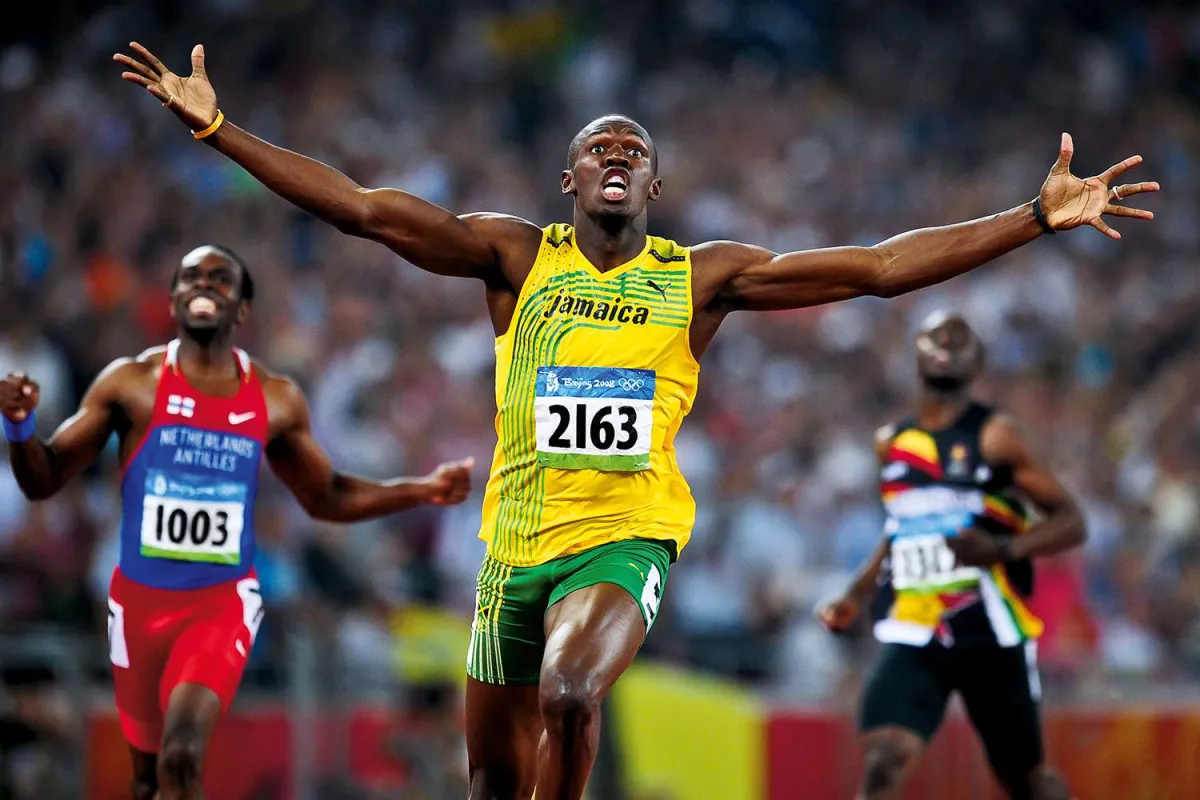 Photo: Usain Bolt, via people.com
Modern timing systems have pushed precision to places the stopwatch pioneers couldn't have imagined. Fully automatic timing, synchronized to the starting gun's electronic signal and captured by high-speed cameras, now measures to the thousandth of a second. Transponder chips, laser beams, and GPS tracking give coaches and athletes data that goes far beyond finish-line times — split times at every 10 meters, acceleration curves, velocity peaks, deceleration rates in the final stretch.
A modern sprinter doesn't just know their final time. They know exactly where they lost the race.
What Ancient Eyes Could Never See
The Greeks watching a footrace in Olympia saw drama, beauty, and the favor of the gods expressed through human speed. What they couldn't see was that one runner accelerated faster off the start, another peaked at 60 meters, and a third faded in the final stretch because of a slight mechanical inefficiency in their left hip.
Modern timekeeping didn't just make records more precise. It made the human body legible in a way it had never been before. Every millisecond of data is a clue. Every split time is a chapter in the story of a performance.
The stopwatch started as a tool for determining winners. It ended up becoming a telescope pointed at the limits of human physiology — revealing things about what we're capable of that no ancient Greek judge, no matter how sharp their eyes, could ever have imagined seeing.