When Split Seconds Didn't Matter: The Ancient Greek Art of Calling Dead Heats
The Judge's Dilemma
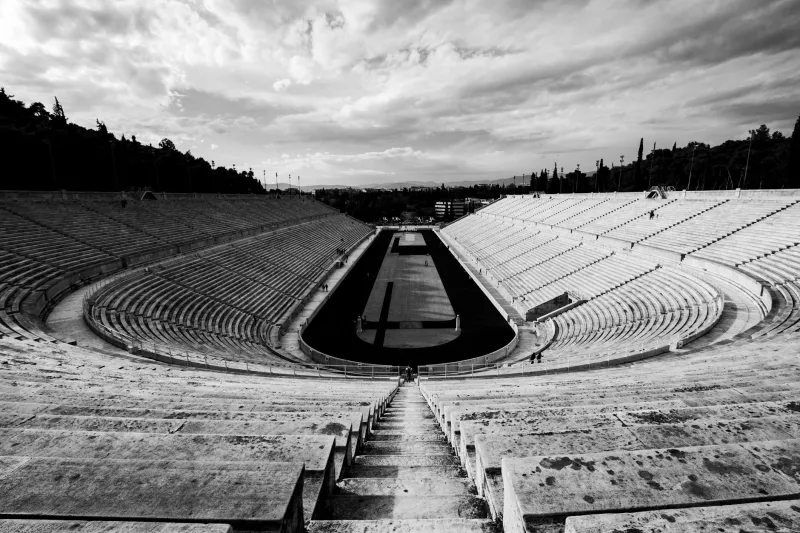
Picture this: Two runners sprint toward the finish line at the ancient Olympics in Olympia, their feet pounding the hard-packed earth as 40,000 spectators roar from the hillsides. They cross together in what appears to be a perfect tie. No slow-motion replay. No photo finish. No electronic timing accurate to the thousandth of a second.
Just ten elderly Greek men called Hellanodikai — the judges — squinting in the Mediterranean sun, trying to make a call that could spark riots.
This wasn't a rare scenario. Ancient Olympic records mention several disputed finishes that created genuine political crises. Unlike today's sports, where technology provides definitive answers, ancient competitions operated on an entirely different philosophy of fairness and human judgment.
The Human Eye as Final Authority
The Hellanodikai weren't just referees — they were revered religious officials chosen for their wisdom and moral character. When faced with a dead heat, they had three main options, none of which involved splitting hairs over microseconds.
First, they could declare a tie and award victory to both athletes. This happened occasionally, though it was considered somewhat unsatisfying since Greek culture prized clear winners and losers. The concept of shared glory didn't align with their competitive ideals.
Second, they could order a re-run. Historical accounts describe several instances where tied athletes were required to race again immediately, often while exhausted from their initial effort. This approach treated the tie as evidence that the gods hadn't yet revealed their true champion.
The third option was the most controversial: the judges could simply pick a winner based on their collective observation. This decision was considered divinely inspired, since the Hellanodikai served Zeus himself. Challenging their judgment was tantamount to questioning the gods.
When Politics Met Photo Finishes
The most famous disputed finish in ancient Olympic history involved two runners from rival city-states — a scenario that would be like having athletes from New York and Boston tied for Olympic gold during the height of their baseball rivalry.
According to the historian Pausanias, the judges' decision sparked a diplomatic incident that lasted decades. The losing city-state accused the Hellanodikai of bias, while the winning city claimed divine vindication. Modern sports fans complaining about referee calls have nothing on ancient Greeks arguing about Olympic results.
 Photo: Pausanias, via myquickurl.com
These disputes reveal something fascinating about ancient athletic culture. Victory wasn't just about crossing a line first — it carried enormous political, religious, and social weight. An Olympic champion brought glory to their entire city-state, often receiving lifetime benefits equivalent to winning the lottery.
The Philosophy of Imperfect Judgment
What's remarkable is how the ancient Greeks embraced the imperfection of human judgment. They understood that close calls were inherently subjective, and they built their entire system around accepting that uncertainty.
Modern sports operate on the opposite principle. We've spent billions developing technology to eliminate human error: photo finish cameras that capture 1,000 frames per second, electronic timing systems accurate to 0.001 seconds, and instant replay systems that can detect the slightest infractions.
Yet even with all this technology, we still have controversial calls. The 2016 Olympic swimming finals saw multiple races decided by hundredths of a second, sparking debates about whether such tiny margins are meaningful or just technological noise.
Lessons from Ancient Improvisation
The ancient approach offers surprising insights for modern sports. By accepting that some outcomes are genuinely ambiguous, the Greeks focused on the broader meaning of competition rather than obsessing over precise measurements.
They also understood something we've forgotten: the human element isn't a bug in the system — it's a feature. The drama of disputed calls, the authority of respected judges, and the acceptance of imperfect outcomes were all part of what made ancient Olympic competition compelling.
Consider how different modern sports might be if we adopted some ancient Greek principles. What if ties in swimming were settled by immediate re-races? What if controversial calls in football were decided by a panel of respected former players rather than video review?
From Eyeballs to Electronics
The evolution from ancient judgment calls to modern precision timing reflects our broader cultural shift toward quantification and technological solutions. We've gained accuracy but lost something in the process — the acknowledgment that sports, at their core, are human endeavors with inherently human limitations.
The next time you watch a photo finish decided by thousandths of a second, remember those ancient Greek judges squinting in the sun, making momentous decisions with nothing but their eyes and their wisdom. They may not have gotten every call right, but they understood something we're still learning: sometimes the most important victories aren't measured in split seconds, but in the courage to make difficult decisions when the outcome isn't clear.
Their legacy lives on every time an official makes a judgment call, reminding us that even in our age of instant replay and electronic precision, sports ultimately depend on human beings making human decisions under pressure.