Leaning Into the Bend: The Long Quest to Unlock the 200-Meter Curve
The 100 meters is a pure, brutal argument. Fastest human wins. There are no tactics, no strategy, no geometry to solve. You run in a straight line as fast as you possibly can, and the stopwatch renders its verdict.
The 200 meters is something else entirely.
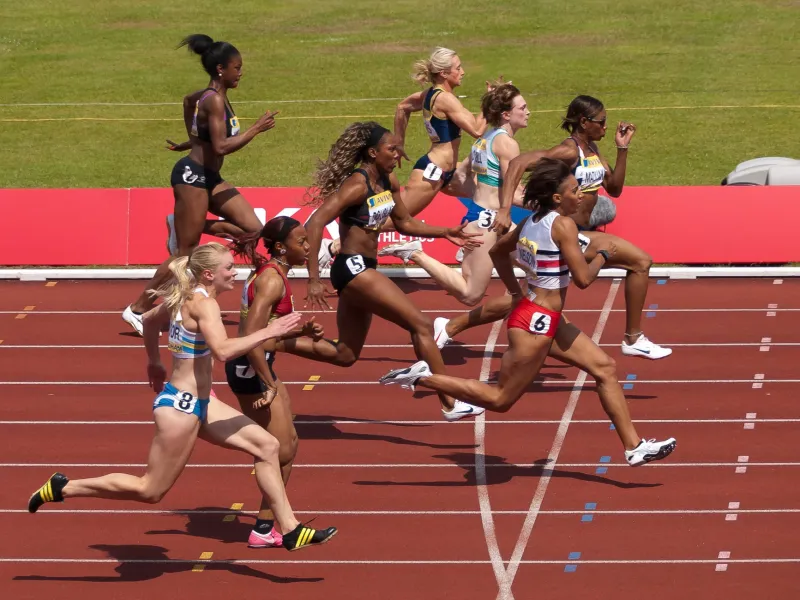
It is two races stitched together by physics. The first half is a curve — a 100-meter arc that demands a completely different kind of speed, one that fights centrifugal force with every stride. The second half is a straight, where a sprinter who's burned too much on the bend arrives with nothing left, and one who's conserved just enough can fly. Getting the ratio right, understanding how to carry speed around a turn without hemorrhaging it, took American sprinters — and coaches, and eventually biomechanists — the better part of a century to fully figure out.
Athens to the Early American Dominance
When the 200 meters appeared on the Olympic program in 1900 in Paris, it was treated largely as a bonus sprint — a longer version of the 100 that rewarded the same qualities. American athletes dominated early, as they did across the sprints, largely on the strength of raw explosive talent and the organizational advantage of well-funded college track programs.
But even in those early years, coaches noticed something puzzling. Athletes who were clearly faster in the 100 sometimes didn't translate that speed into 200-meter dominance. The curve was doing something to them — costing them time, disrupting their stride, forcing compensations that added up to lost tenths of a second by the time they hit the straight.
The problem was that nobody had a precise language for what the curve was doing. Coaches gave advice that was more intuitive than technical: lean into it, don't fight it, relax through the turn. Some of it worked. None of it was systematic.
The Physics Nobody Was Teaching
Here's what was actually happening, even when coaches couldn't articulate it.
Running a curve at sprint speed generates centrifugal force — the tendency of a moving body to continue in a straight line, which means the athlete is constantly being pulled toward the outside of the track. To counteract this, sprinters must lean inward, tilting their entire body toward the center of the curve. But that lean changes the geometry of every stride. The foot strike moves inward, the hip extension changes, the arm drive must compensate for the altered body angle.
Do it wrong and you're fighting the curve, wasting energy on muscular tension that should be going into forward propulsion. Do it right and the lean becomes part of the movement, a controlled fall that actually uses the curve's geometry to maintain momentum.
Early American sprinters were largely doing it by feel. The ones who got it right had often stumbled onto the correct body position through trial and error. The ones who didn't left time on the track without knowing why.
The lane assignment adds another layer of complexity. Athletes in the outer lanes run a slightly less severe curve — the radius is larger, the centrifugal force slightly lower. In the inner lanes, the curve is tighter and the challenge greater. Staggered starts mean runners can't see their competitors directly, which removes one of the most powerful psychological tools a sprinter has. You can't chase what you can't see.
Tommie Smith and the Geometry of Speed
If there's a single athlete who demonstrated what fully solved 200-meter running looked like, it's Tommie Smith at the 1968 Mexico City Olympics.
 Photo: Tommie Smith, via fraulocke-grundschultante.de
 Photo: Mexico City Olympics, via a.cdn-hotels.com
Smith's 19.83-second world record that night — run at altitude, yes, but still a performance of staggering technical quality — was a revelation. Film analysis of that race shows a sprinter who had internalized the curve so completely that his transition from bend to straight was virtually seamless. Where other athletes visibly shifted their mechanics coming off the turn, Smith simply continued accelerating. The curve wasn't a problem to be managed. It was the first half of one continuous movement.
Smith had worked obsessively on the bend. Under coach Bud Winter at San Jose State, he'd developed a training approach that treated the 200 as a distinct event with its own technical demands, not simply a longer sprint. Winter's coaching philosophy emphasized relaxation at speed — the idea that muscular tension was the enemy of fast running — and nowhere was that more applicable than on the curve, where anxious athletes tended to tighten up and fight the physics instead of flowing with them.
 Photo: San Jose State, via lookaside.instagram.com
The iconic raised fist at the medal ceremony has rightly defined Smith's legacy in a larger sense. But the running was extraordinary on its own terms.
The Biomechanics Revolution
Through the 1970s and 1980s, as sports science began to professionalize, researchers started applying motion capture and force plate analysis to sprint mechanics. The 200-meter curve became a legitimate subject of study.
What they found confirmed what the best coaches had been teaching by instinct: the optimal lean angle for a given speed and curve radius could be calculated mathematically. Foot strike position relative to the body's center of mass could be measured and optimized. The timing of the transition from curve to straight — when to begin shifting body position, how many strides before the straight to initiate the change — could be analyzed and taught.
American sprint coaches began integrating this research into training. Curve-specific drills became standard. Sprinters practiced the lean in isolation, at slower speeds, building the neuromuscular pattern before applying it at race pace. The intuitive became teachable.
The Record Books Redrawn
The results showed up in the times. The 200-meter world record has been one of track and field's most contested benchmarks, with American sprinters central to its evolution. From Smith's 1968 mark through Frank Shorter's era of distance dominance, American sprinting has periodically reasserted itself in the 200, each generation benefiting from the accumulated technical knowledge of the one before.
The event today is run with a level of curve mastery that would have seemed almost superhuman to coaches in 1900. Athletes exit the bend at speeds that the early Olympic sprinters couldn't maintain on a straight. The physics haven't changed. The understanding of how to work with them has been completely transformed.
Why the Curve Still Matters
The 200 meters remains one of track and field's most technically demanding events precisely because of what the curve requires. It's not enough to be fast. You have to be fast in a specific, geometrically constrained way, and then sustain that speed through a transition that disrupts everything your body wants to do naturally.
From the first stumbling attempts to solve the bend in Paris in 1900 to the fluid mastery of modern Olympic finals, the story of the 200 meters is a story about how athletic knowledge accumulates. Coach by coach, race by race, film reel by film reel, and eventually data point by data point, a generation of athletes and thinkers figured out how to lean into something that was pushing back hard.
The curve didn't change. The humans who learned to run it did.