Faster, Higher, Longer: Why Women's Athletic Records Are Falling Off a Cliff — and What That Really Means
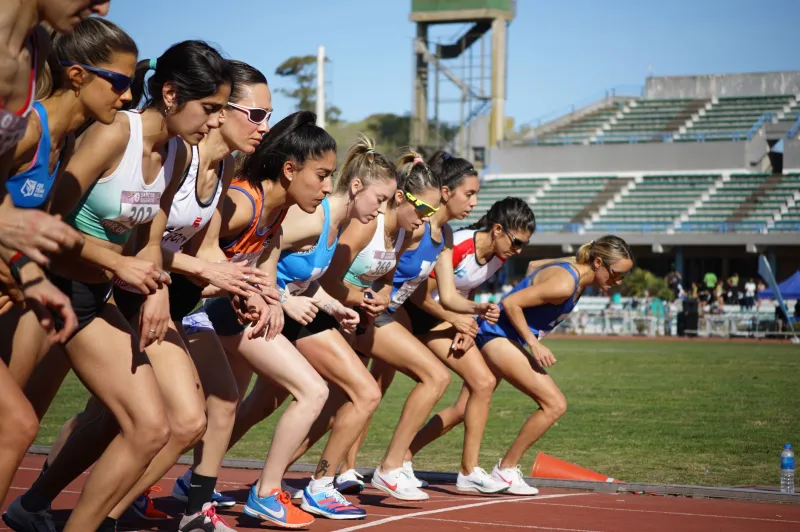
Run the numbers on Olympic track records from 1960 to today and something jumps out immediately. Men's records have improved, no question — but incrementally, in the way you'd expect from a century of marginal gains in training, nutrition, and equipment. Women's records, in event after event, have dropped at a pace that looks almost implausible by comparison. The 1964 women's 800-meter Olympic champion ran 2:01.1. The current world record is 1:53.28. That's nearly eight full seconds — an enormous gulf in a two-minute race.
To understand why, you have to go back further than the records themselves. You have to go back to the conditions that produced them.
The Starting Line Wasn't the Same for Everyone
Women didn't compete in the ancient Olympics at Olympia — full stop. The games were an exclusively male institution, tied to religious ceremony and civic identity in ways that explicitly excluded female participation. Women had their own festival, the Heraia, which involved a foot race for unmarried women, but it was a fraction of the scale and prestige of the main games.
Fast-forward to the modern Olympics, revived in 1896 in Athens, and the situation had barely improved. Women were absent from the first Games entirely. By 1928, they were finally allowed to compete in track and field — but the experiment nearly ended before it started. After the 800-meter final in Amsterdam, several runners collapsed from exhaustion at the finish line. The sight prompted a wave of hand-wringing from officials and commentators who declared the distance too grueling for female constitutions. The women's 800 meters was pulled from the Olympic program and didn't return until 1960.
The marathon? Women weren't allowed to run it officially until 1984 in Los Angeles. Kathrine Switzer had famously entered the Boston Marathon in 1967 under her initials to avoid detection, only to have a race official physically try to remove her from the course. The idea that women's bodies were fundamentally unsuited to endurance events wasn't fringe thinking — it was institutional policy.
What Suppressed Records Actually Tell Us
Here's the critical point that gets lost in straightforward comparisons of times and distances: a record only measures what was permitted to be attempted. When women were barred from certain events, given shorter distances, or actively discouraged from serious training, the records they set weren't reflecting biological potential. They were reflecting the ceiling of what a systemically disadvantaged population could achieve under constrained conditions.
This is why the improvement trajectory looks so steep. Every decade that passed brought new cohorts of women with better access to coaching, facilities, sports science, and institutional support — and the records responded accordingly. The drop wasn't a mystery. It was overdue.
Consider the women's marathon. Joan Benoit Samuelson won the first Olympic women's marathon in 1984 with a time of 2:24:52 — itself extraordinary given how recently women had been allowed to train seriously for the distance. Today, the world record stands at 2:09:56, set by Tigst Assefa in 2023. That's a 15-minute improvement in roughly 40 years, a rate of change that has no equivalent on the men's side of the ledger.
The Numbers, Side by Side
Look at specific events and the gap in improvement rates becomes even clearer.
In the 100 meters, the men's world record has moved from 10.0 seconds (hand-timed, 1960s) to 9.58 seconds today — an improvement of roughly 4 percent. The women's record has moved from 11.5 seconds in the early modern era to 10.49 seconds, an improvement closer to 9 percent, from a later and lower baseline.
In the shot put, men's records have climbed steadily since the 1950s. Women's records, particularly during the era when Eastern Bloc nations began investing heavily in female athletics, exploded upward at a pace that reflected decades of untapped potential suddenly being developed.
The pattern holds across swimming, cycling, rowing, and field events. Women's records are moving faster because they had further to travel — and because the infrastructure supporting female athletic development has been catching up, event by event, decade by decade.
What's Still Left on the Table
The uncomfortable implication of all this data is that we genuinely don't know what women's athletic potential looks like at full expression. Men have been training with elite coaching, scientific support, global competition, and institutional backing for far longer. Women are still, in many corners of global sport, working against structural disadvantages — unequal pay, unequal media coverage, unequal access to facilities and medical research.
Sports science itself has historically used male bodies as its default research subject. Nutrition guidelines, training protocols, recovery strategies — much of the foundational research was conducted on men and applied to women as an afterthought. That's changing, but slowly.
What this means in practice is that women's records are likely to keep falling faster than men's for the foreseeable future. Not because female athletes are outpacing their male counterparts biologically, but because the gap between current performance and actual potential remains wider. Every year that passes with better research, better coaching, and more equitable access to resources is a year where that gap narrows — and the record books reflect it.
A Different Kind of Progress
The story of women's athletic records isn't just a sports story. It's a story about what happens when a population is systematically prevented from competing on equal terms and then — gradually, incompletely, still imperfectly — allowed to try.
From ancient Olympia, where women watched from a distance, to the modern track, where American women have become among the most dominant sprinters and distance runners on the planet, the arc is long and the progress is real. But the data keeps suggesting there's more to come. The records we're celebrating today may look like the slow early laps of a race that's still being run.